
The Penitent
“Purity is not measured in mercy. It is measured in the number of corpses left behind.”
InThe thePenitent past year, as the Blight spread across Faulmoor,is a white-veiled religious executioner whose name has surfacedbecome associated with uncompromising judgment, suspected Blight, and the harsher edges of Lathanderite zealotry.
Little about his identity is publicly certain. What is consistent across surviving accounts is his appearance: a tall figure in whispers—notplain armor, a titlewhite ofveil rankmarked or lineage,surrounded butby scripture, and a namemassive spokensilver withgreatsword dread.known Theas PenitentSun is not a man to be reasoned with, nor is he a soldier to be bribed or turned aside. He is a force of absolute judgment, an executioner who neither seeks nor requires approval. Where the Blight lingers, he follows, and where he walks, no one remains to speak of him.Sorrow.
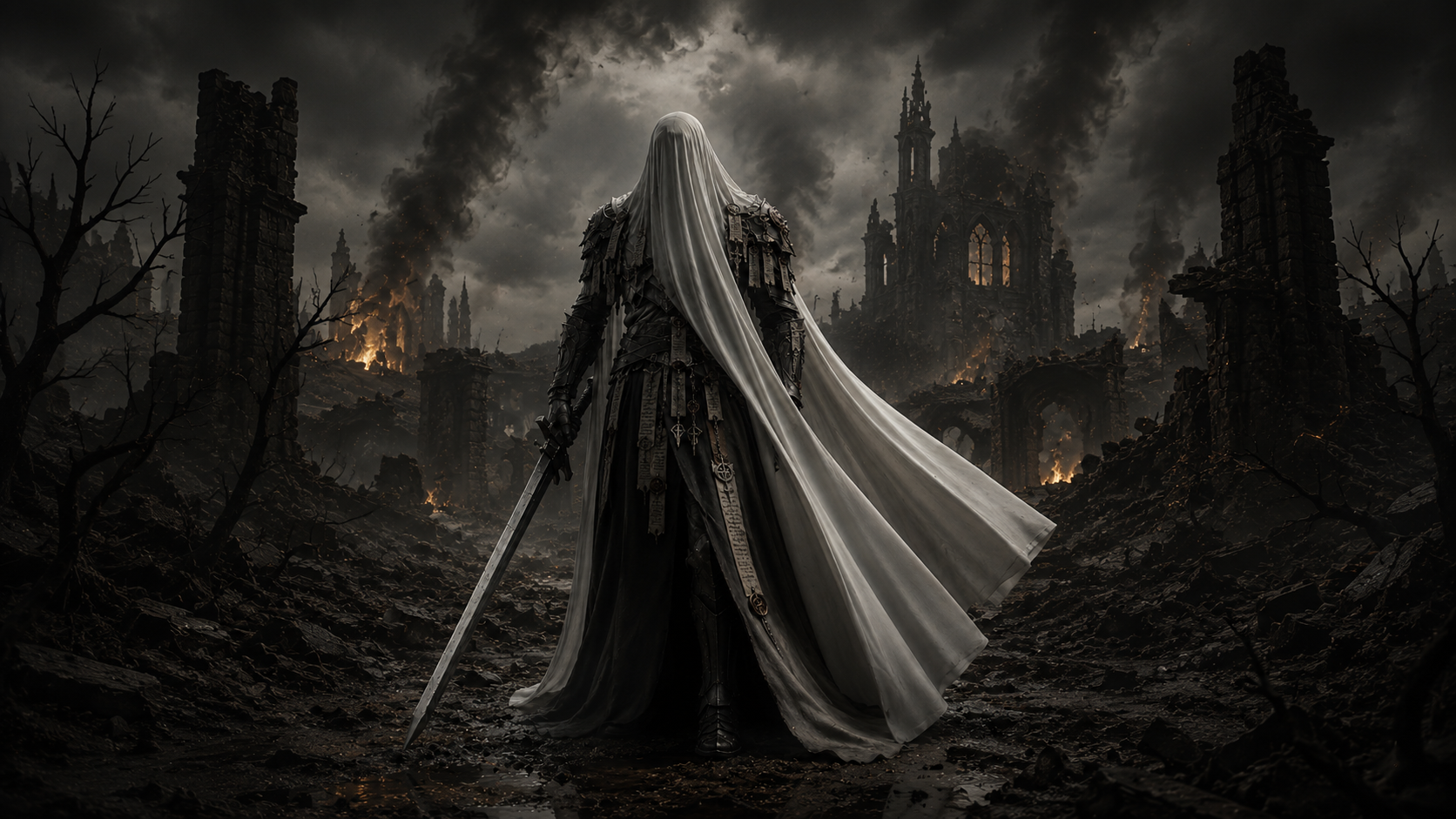
Overview
The Penitent is widely described as silent, controlled, and unnervingly still. Witnesses rarely describe rage, threats, or theatrical displays. Instead, accounts emphasize certainty. Once he has judged someone or something dangerous, there appears to be little room for argument, negotiation, or appeal.
This has made him a symbol of religious severity to some and a figure of terror to others. Admirers describe resolve and purity of purpose. Critics describe a man whose faith has left no space for mercy or doubt.
Appearance
The Penitent is described as unusually tall and motionless when at rest. His armor is practical and relatively plain. Slips of scripture are pinned across his clothing and equipment, while a white veil or cowl conceals his entire face and hangs down across his upper body.
No onereliable knowsaccount whoestablishes what lies beneath the veil. Stories that describe an empty hood, a missing face, or something no longer human are part of the mythology surrounding him rather than verified fact.
His principal weapon is Sun Sorrow, a massive silver greatsword. Witnesses have described him wielding the blade with remarkable ease.
The White Veil
The veil is responsible for many of the stranger stories surrounding the Penitent.
People attempting to watch him directly describe visual strain, rippling or doubled outlines, sudden errors in judging distance, and the unsettling impression that he is.has Somemoved believewithout crossing the space between. Others report hearing almost nothing as he isapproaches.
These agenteffects ofhave aproduced noblewidespread house,rumors sanctionedthat the Penitent can vanish, teleport, or step outside ordinary sight. No reliable public explanation for the phenomenon exists.
Some survivors claim that reflections behave differently. A figure impossible to purgefollow thedirectly infectedmay withoutappear remorse.more Othersclearly claimin hestanding water, polished glass, mirrors, or other reflective surfaces. Whether this is a rogue,consistent limitation or merely another traveler's story remains uncertain.
Beliefs and Reputation
The Penitent is closely associated with religious purification, scripture, and severe interpretations of Lathanderite doctrine.
He is generally portrayed not as a zealotkiller actingseeking beyondpleasure, thebut reachas ofa law,believer answeringwho onlyconsiders violence morally necessary. This distinction does little to his own convictions. There arereassure those who sayfear him. The idea that he doesmay notact servewithout anyanger, houserevenge, ator all,personal gain has become one of the most disturbing parts of his reputation.
Stories told across Faulmoor attribute executions, purges, and the destruction of suspected contamination to him. The details vary sharply between tellings. Some accounts place him in the service of powerful patrons or religious authorities, while others insist he answers to no one.
Claims that he is a manifestationghost, ofa Blightborn creature, a divine manifestation, or something without a human face are common but unproven.
Sun Sorrow
Sun Sorrow is the land’name consistently given to the Penitent's suffering,great silver sword.
Beyond its size, material, and association with him, little reliable information about the weapon is publicly available. It is widely rumored to be a ghost clad in white who walks the ruinsrelic and delivers a justice as unfeeling as the Blight itself. He is rarely seen, and those whoto have facedbeen him rarely live long enoughgiven to speak of it. And those who survive, in time, find themselves struggling to recall the details of what they saw—if they saw anything at all.
The Penitent operates with chilling efficiency. His presence is never announced, nor is it met with warnings or proclamations. He arrives in silence, passes judgment without debate, and leaves behind only the dead. To be seen by the Penitent isby toHouse be measured, to have one’s life weighed against his unwavering standard of purity. There are no second chances. A single sign of infection—fever, fatigue, a poorly healed wound—is enough to warrant execution. There is no interrogation, no trial, no appeals to mercy. Mercy, he believes, is the root of all weakness, the rot that allows the Blight to spread.
Though no one has seen his face, his presence is unmistakable. He wears a white cowl, but beneath it, there is no face—only a void, only the absence of identity. His veil lags behind his movementsWilthorne, a breathstory slower than it should be, as if the shroud itself is unsure whether it still drapes over something real. His armor is practical, built for movement rather than intimidation, though itthat has longstrengthened since taken on an aura of dread. The white fabric he wears never seems to stain, even when it should be bathed in the blood of those he kills. Some claim that beneath the veil, there is nothing at all, that his humanity has long since faded from existence. Others whisper that his voice, low and measured, does not sound entirely human, as if it does not belong to the thing that wears the veil at all. He moves with quiet certainty, never rushing, never hesitating, never showing even the faintest flicker of doubt.
His weapon, a long and thin silvered greatsword known only as Sunsorrow, is always wrapped in white cloth, its pristine blade glinting beneath the folds like an instrument of divine punishment. It is a blade that never rusts, never dulls, and never hesitates. Those who have seen it drawn know that its edge is not reserved only for the infected. Any who stand in his way are cut down with the same unwavering precision. The Penitent does not suffer interference. He does not negotiate. He does not see civilians, soldiers, or nobles—only the pure and the impure.
But Sunsorrow is not his only tool. Where steel does not suffice, fire does.
Fire, to the Penitent, is the ultimate cleanser. It does not discriminate, it does not falter, and it does not leave room for doubt. If the body cannot be trusted to remain pure, then neither can the land it touches. There have been countless occasions where, rather than swinging his blade, the Warden simply burned entire settlements to the ground. He carries with him a series of iron censers, each filled with a thick, alchemical mixture that ignites instantly upon exposure to air. With a single throw, the contents explode in gouts of flame, consuming everything in their path. Buildings, bodies, even the very earth itself—nothing is left behind but scorched ruins and smoke curling into the sky like the last prayers of the condemned.
There is no hesitation in the way he wields fire. He does not wait to confirm an infection, nor does he seek to isolate the afflicted. If a town stands too close to the Blight, he will ensure that it stands no longer. There is no difference in his eyes between a sick child and a house that once held the sick—both are fuel for the pyre. His methods are not simply about execution. They are about erasure. The infected do not simply die; they are removed, their existence burned away as if they had never been.
Rumors of his origin are as varied as they are unsettling. Some believe he was once a noble himself, one who lost everything to the Blight and became something else, something more terrible than grief. Others claim he was a priest who once sought to heal the sick but saw too many fall to the disease and came to believe that fire and steel were the only cures. The most disturbing whispers say that he was never a man at all,suspicions that the Blighthouse didhas notsupported or sponsored him at some point.
Neither the relic claim himnor butthe madealleged somethingWilthorne newgift inis publicly proven. Other stories credit Sun Sorrow with impossible sharpness and divine judgment, though such claims are difficult to separate from the fear surrounding its place, something unfeeling and relentless, something that now walks in human form but is not bound by human limitations.wielder.
Those
See fearAlso
There have been sightings of him across Faulmoor, always where the Blight has taken hold. A village near Duskford, already struggling to survive, was found abandoned overnight, its homes still intact, its doors left open, but its streets empty. Not a single soul remained. There were no bodies, no signs of battle—only the scorched remains of a mass pyre at the edge of the town, as if the Penitent had come and carried out his judgment in a single, horrifying night. Another account, spoken in hushed voices by refugees who fled to Southvale, tells of a mother who begged for her child’s life, swearing the sickness had not taken hold. The Penitent did not speak. He simply drew his blade and killed them both.
His name is spoken in fear but also in reverence by those who believe the Blight is a punishment upon the land, a wound that must be cleansed no matter the cost. There are those who see him as a necessary evil, the last hand willing to do what must be done, and there are those who see him as the worst monster the Blight has yet produced. The truth, if there is one, lies somewhere in between.
One thing remains certain—he does not stop.
You cannot bribe a man who has abandoned his name. You cannot reason with a man who has abandoned his face. You can only run, and hope he does not follow.