
Norvostra Overview
“Norvostra is dying, and the people know it.”
— Aeldric Voss, Explorer of the Lost Lands
Norvostra is the kingdom at the center of the Festering Lands. In the second year of the Rotmire Blight, ordinary questions of travel, food, trade, shelter, and local authority have become matters of survival.
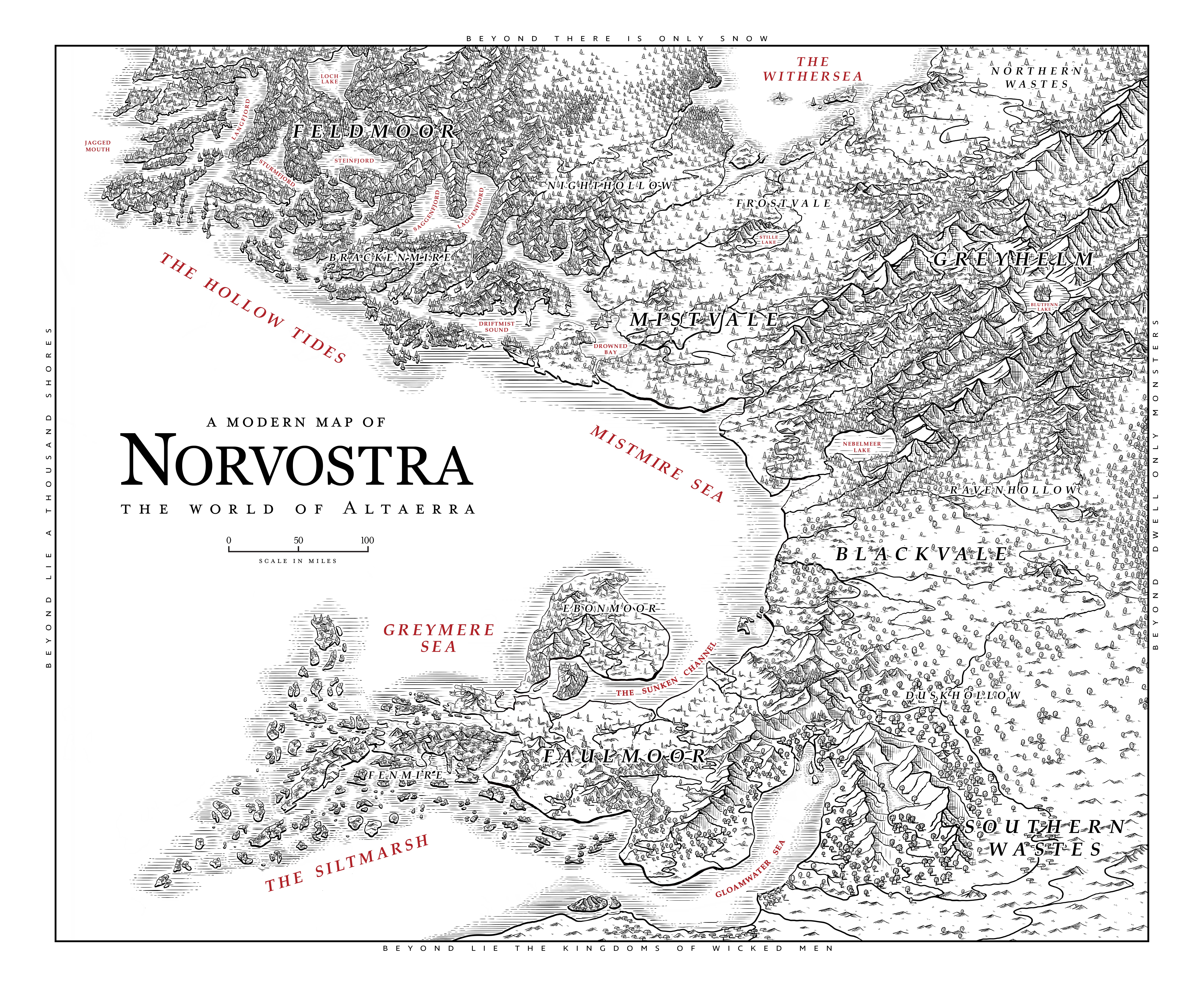
The crisis is most visible in Faulmoor, but Norvostra remains a larger kingdom with surviving communities, regional identities, trade, faith, and political interests beyond the barony. The Blight has fractured old connections without erasing them.

A Kingdom in Crisis
To ordinary people, the Rotmire Blight is a catastrophe that afflicts bodies, land, water, wildlife, and the dead. Fever, darkened veins, ruined fields, polluted waterways, reanimated corpses, and increasingly strange behavior among the Blighted are widely reported, while explanations for transmission and treatment remain contradictory.
The Blight enters daily life through small decisions long before it becomes a monster at the door: which road still feels safe, whose water can be trusted, whether a traveler is admitted, how much grain can be spared, and what a community is willing to do with its dead.
No publicly known cure exists. Fire and silver are treated as the most reliable permanent answers once the Blight has fully claimed the dead, though exact procedures belong to the campaign's live rules.
The crisis has reshaped institutions as thoroughly as it has the countryside. Quarantines, checkpoints, restricted movement, hoarded supplies, bribery, smuggling, and improvised local authority have become ordinary features of life in affected regions.
Faulmoor
Faulmoor is a damp and politically fractured barony where three noble houses hold different pieces of the region's remaining strength.
House Valkenmar retains baronial authority and much of Faulmoor's military power. House Wilthorne rules Ebonmoor and controls strategically important trade and access routes. House Harrowden rules Fenmire and holds enormous leverage through the region's silver supply.
Their interests overlap, but their priorities do not. Cooperation continues because collapse would be worse, not because trust has survived intact.
Beyond Faulmoor
Other regions remain part of Norvostra's public identity even where surviving accounts are less detailed.
Blackvale contains the kingdom's capital and remains associated with noble and mercantile power. Mistvale is remembered for cold fog, superstition, healers, mystics, and old secrets. Greyhelm, high in the mountains, is often called the crown of the world and remains poorly understood by people farther south. Nighthollow carries a reputation for outlawry, criminal trade, and survival by coin.
Older regional traditions also speak of Ravenhollow, Duskhollow, and Frostvale. What the Blight has done to every distant district is not equally well documented, and rumors often travel farther than reliable news.
Silver
Silver has become a survival resource rather than ordinary wealth. Its effectiveness against Blighted creatures has driven the melting of coin, weapon silvering, hoarding, theft, black markets, and political pressure around the sources that remain.
This change has elevated Fenmire and the Thornmere Mines from difficult peripheral holdings into strategically important territory.
The Old Ways
The Old Ways have returned to public relevance as conventional institutions fail to provide convincing answers. People turn toward old rites, relics, pilgrimages, recovered texts, shrines, and half-understood traditions in search of protection or meaning.
There is no single Old Ways church or doctrine. Priests, scholars, relic-keepers, rulers, mystics, opportunists, and frightened common folk often interpret the same surviving traditions differently.
Present Day
Norvostra remains inhabited, governed, traded across, and fought over. The Blight has not erased ordinary life, but it has forced nearly every surviving institution to decide what it is willing to sacrifice in order to continue.
The result is a kingdom where human choices can be as dangerous as the dead: who receives food, who is admitted through a gate, who is quarantined, who controls silver, and which cruelties are accepted in the name of survival.