
Faulmoor Overview
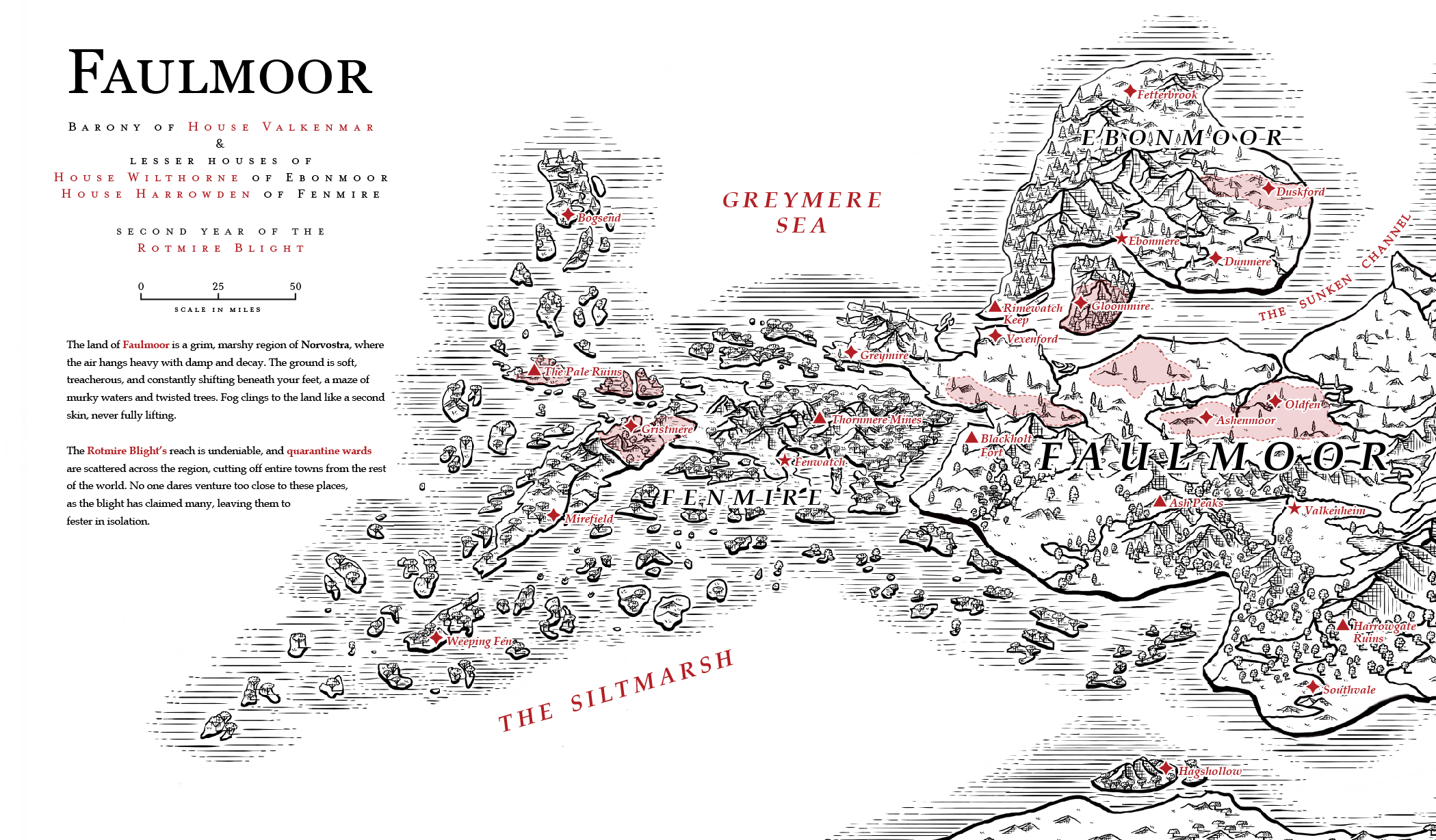
Faulmoor is a landlow, steepedwet in sorrow, where the weightbarony of themarsh, Rotmirefloodplain, Blightreclaimed pressesfarmland, against the hearts of its people as surely as the thick fog that clings to its marshes. The air is heavy with decay, carrying the scent of damp earth, stagnant water,ports, and somethingold fartrade fouler—the distant, cloying rot of the dead.routes. In the second year of the Blight,Rotmire Blight, failing roads and drainage works are allowing water to reclaim abandoned fields and settlements while the landregion's noble houses struggle to preserve authority, trade, and access to silver.
Overview
Before the Blight, Faulmoor's practical strengths were productive farmland, navigable routes, and its position within regional trade. The discovery of rich silver veins in Fenmire later made the barony even more important.
The Blight disrupted the ordinary labor that kept the landscape usable. Roads go unrepaired, drainage fails, fields soften into marsh, and abandoned settlements flood from the ground upward. Routes once regarded as seasonal inconveniences can now become impassable barriers.
Faulmoor remains inhabited and traveled, but survival is neitheruneven. fullyFortified consumedcities, norisolated trulyvillages, untouched,river existingstations, insmuggling ports, quarantine zones, and ruined settlements may lie only a purgatoryfew days apart. Farmers, ferrymen, soldiers, traders, scavengers, smugglers, and refugees all compete to keep movement possible across a landscape that becomes less dependable every season.
History
Faulmoor was governed through House Valkenmar, with House Wilthorne of slowEbonmoor decline.and House Harrowden of Fenmire serving as powerful vassal houses.
That arrangement depended on military protection, trade, and access to resources moving between the three regions. The deeperBlight reachesplaced all three under pressures that reward isolation and self-preservation, weakening relationships that were already unequal.
The first year of the swampscrisis pulseproduced withseveral containment disasters that hardened later policy across the foul sickness,barony and abandonedleft hamletsentire sagstretches beneathof countryside abandoned.
Present Day
House Valkenmar retains baronial authority from Valkenheim, but its forces and administrative reach are stretched thin. This is particularly visible in places such as Greymire, where formal authority still exists but practical control depends heavily on local operators and negotiated tolerance.
Ebonmoor remains strategically important for trade and controlled access. Fenmire's silver gives House Harrowden leverage far beyond the political weight ofthe creepingmarsh moldregion once held.
Across the barony, quarantine policy, scarcity, smuggling, private violence, religious revival, and deathlesslocal hunger.improvisation Butincreasingly shape daily life. Faulmoor is not yetuniformly lost—itsruined. roadsSome aresettlements still traveled, its villages still clingcontinue to life,function, but the distance between a working market and itsan peopleabandoned stillroad fightcan forbe whateververy scraps remain.small.
At
Notable heartLocations
Valkenheim
, a fortress-city of iron discipline and cold sacrifice,is the seat of . and the traditional political center of Faulmoor. Its wallsfortifications and administrative importance have only grown as the surrounding region has become less reliable.
Vexenford
controls the mainland approach toward Ebonmoor and the major crossing leading toward the island. Its layered construction, checkpoints, and strategic position make it one of Faulmoor's most important controlled gateways.
Greymire
is a coastal trade and smuggling hub where legitimate commerce, contraband, information brokerage, refugee movement, and relic traffic overlap.
Oldfen and Ashenmoor
is a ruined quarantine settlement whose failed containment wall became one of the defining disasters of the Blight's first year. Nearby fell rapidly after Blighted from Oldfen reached its unfinished defenses.
The Pale and Blackholt Fort
The Pale is one of Faulmoor's best-known quarantine regions, a broad drowned landscape where abandoned infrastructure and prolonged Blight exposure have reshaped the countryside. , farther south, remains Faulmoor's largest major fortress and an important military landmark.
The Ash Peaks
rise likenear blackenedValkenheim teethand againstremain theone sky,of unyieldingFaulmoor's againstleast bothcontrolled regions, known for difficult passes, abandoned workings, and persistent relic legends.
Southvale
was once known for fertile countryside and river access. The arrival of wealthy refugees during the Blight transformed its social order and intensified conflict over food, property, and local power.
The Harrowgate Ruins
are a partially submerged ancient site southeast of Valkenheim, visited by pilgrims, scholars, and relic-seekers despite their reputation for strange phenomena.
Major Regions
Ebonmoor
is an island domain ruled by House Wilthorne. Its trade routes, bridge access, and relative isolation give it unusual leverage within the desperationbarony.
Fenmire
who would seek shelter within. The nobility here rule with unflinching cruelty, sacrificing thousands to keep the sickness at bay. Eastward, , onceis a thrivingdifficult stronghold,marsh nowregion servesruled asby littleHouse moreHarrowden. thanIts asilver checkpointdeposits, of suffering, where enforced quarantinewaterways, and ruthless order have turned the streets into a cage of slow, inevitable death.
Beyond these bastions of power, the land becomes wild and lawless. The smuggler’s haven of thrives in the chaos, where silver changes hands as swiftly as knives in the dark. Here, anything can be bought—false identities, stolen relics, desperate passage through forbidden lands—but nothing is ever free. Further inland, , known as the Walled Grave, stands as a grotesque monument to House Valkenmar’s unyielding containment policies. Its crumbling barricades now serve only to trap the shambling remnants of its former inhabitants, their hollowed moans carried by the wind as a warning to those who would seek escape.
The tragedy of plays out in slow motion, its people trapped between denial and doom. Here, the half-built barricades were meant to keep the dead out, but instead, they now serve only to remind its survivors that the walls were never finished. Every night, the undead scratch at the wood, dragging themselves forward with relentless, mindless hunger. , once a proud military stronghold, has become a sanctuary of last resort, its halls crammed with desperate souls. The once-disciplined soldiers stationed thereisolation have become little more than glorified wardens, strugglingcentral to keepFaulmoor's bothsurvival the refugees and their own dwindling morale in check.economy.
To
See east,Also
Further south,
And beyond it all, half-swallowed by the marshlands, the stand as a testament to a forgotten age. Buried beneath thick brambles and drowned in stagnant waters, the ruins hum with an eerie presence. Some claim to hear whispers on the wind, voices from an age long past, calling out to those who dare disturb their slumber. Others seek the lost relics hidden beneath the stone—artifacts of a world before the sickness, before the fall.
But Faulmoor’s ruin is not solely the work of the Blight. Its noble houses have done as much damage as the sickness itself, turning on one another in a desperate bid for power. ,
In the west,
To the south, of , once a forgotten name, now holds the most valuable resource in Faulmoor—. Their mines in are among the last remaining sources of the precious metal, and Lord has made certain that every noble pays for their past neglect. Isolated and embittered,
Together, these three houses form a fragile, crumbling balance—a triangle of necessity, ambition, and hatred. Valkenmar’s military, Wilthorne’s trade, and Harrowden’s silver are all that stand between Faulmoor and complete collapse. Yet none of them trust one another, and should one falter, the others will seize their chance.
Faulmoor is neither fully dead nor truly alive. It is a land in twilight, teetering on the edge of oblivion. The Blight spreads, but not with the mindless hunger of a wildfire—it is slow, insidious, creeping like roots beneath the soil, ready to strangle the last remnants of civilization when they least expect it. The nobles fight to maintain their fractured dominion, the common folk struggle to survive, and in the dark corners of the land, the dead whisper and wait.
When Faulmoor finally falls, it will not be to war or conquest. It will be to rot, ruin, and the simple, inevitable weight of time.