
The Shambler
The Restless Rot
“They are the ones we expected. The ones we thought we understood. The ones we thought we could handle. But it is not just their hunger that makes them
terrifying—itterrifying. It is their numbers.”
When people speak of the Rotmire Blight, they often conjure images of horrors beyond comprehension—Whisperers that mimic lost voicesShamblers, Broken Lords that fight as they did in life, or the Stillborn, forever watching. But those are merely the variations, the mutations of something far older, far simpler. The Hollowed Dead are the true heart of the Blight—the inevitable, the endless, the unavoidable fate of those who perish upon this cursed land.
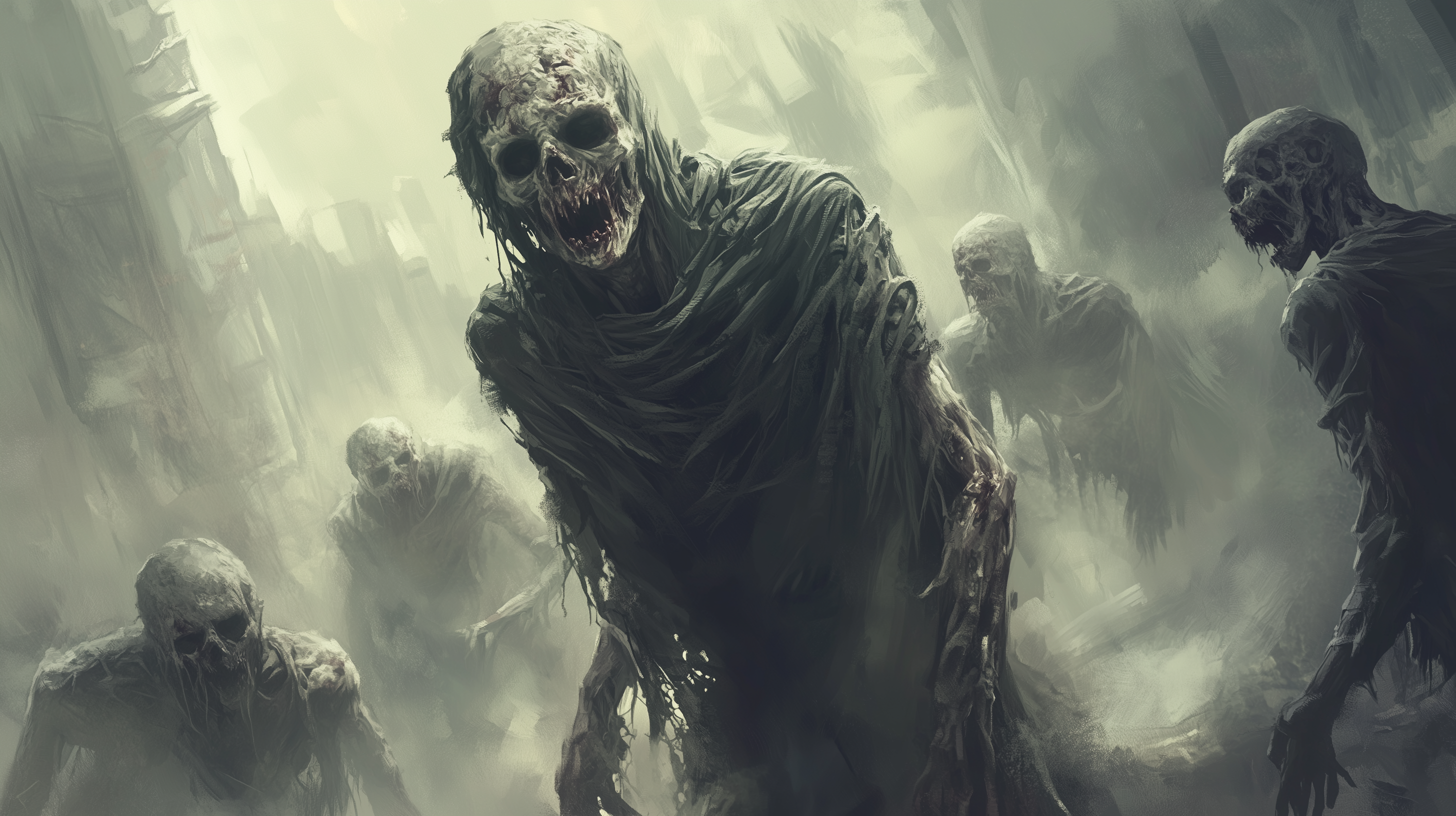
They are what remains when the flesh refuses to rest. The Hollowed Dead, or Shamblers, were once farmers, hunters, soldiers, nobles—people who thought death would be their final chapter. Instead, they rise, stripped of all thought, all memory, reduced to nothing but hunger and instinct. Some shamble slowly, their decomposed limbs barely able to carry them forward. Others move with unnatural speed, driven by an urgency that no longer serves a purpose. But all of them seek the same thing—the warmth of the living, the pulse of something they can no longer have.
They are the most common form of Blightborn encountered in Faulmoor. Older field notes sometimes call them the Hollowed Dead, but Shambler is the name most travelers, soldiers, and survivors use.
Appearance
A Shambler is recognizably the corpse of the Blighted,person it once was. Clothing, tools, old wounds, and perhapssigns of occupation often survive long after identity has been lost. Decay varies widely. Some are gray and waterlogged, while others are desiccated, burned, partially skeletal, or swollen by exposure.
Their movement is usually slow and badly coordinated. Limbs drag, feet catch on roots and broken stone, and individual bodies often look more pitiful than dangerous. That impression becomes less useful once several are moving together.
Behavior
Shamblers display little of the deception or specialized behavior associated with rarer Blightborn. They wander, collect around movement and noise, and press toward living creatures once roused. Their danger comes less from individual strength than from persistence and numbers.
A lone Shambler often indicates that more are nearby. Roads, abandoned settlements, failed quarantine sites, battlefields, and places where bodies were never properly cleared can hold large concentrations.
Not every Blighted corpse moves at the same pace. Survivor accounts occasionally describe faster individuals breaking from a larger mass, but these differences are usually treated as variation among Shamblers rather than a separate named form.
Field Knowledge
Shamblers have given rise to many of the basic survival practices associated with the Blighted. Noise discipline matters because a small disturbance can gather more bodies than travelers can safely fight. Open ground gives warning and room to withdraw. Tight interiors, alleys, and collapsed structures can turn a handful of slow corpses into a trap.
Silver remains the most dangeroustrusted formeans thatof reasonpermanently alone.dealing Onewith HollowedBlighted Deadcreatures. Fire is noalso threat.widely Fiveused arein corpse disposal and containment, though survivors distinguish burning a nuisance.body Ten are a problem. But whenfrom the moanscertainty of the dead begin to rise in unison, when the ground tremblesassociated with their ceaseless march, when there is nowhere left to run… then you will understand what the Blight truly is.
The Hollowed Dead are exactly what they appear to be—the mindless, shambling remnants of the fallen. They are neither particularly strong nor particularly fast, but they make up for this in sheer numbers. One is not a threat. Five are manageable. But a hundred? A thousand? That is the true horror of the Hollowed Dead. If you must fight them, fire is your greatest tool—a single torch can clear a path through a swarm of them. Silvered weapons cut through them with greater efficiency, but if overwhelmed, your best strategy is to create distractions—they are drawn to movement and sound more than anything else. Most importantly, identify the runners early—some Hollowed are faster than others, and they will reach you first if given the chance. If you hear the moans of the dead, you have already wasted too much time. Leave before they arrive.
They do not think. They do not feel. They do not stop. And when the last of Faulmoor’s lights are extinguished, when the final doors are broken down, when the last survivors are dragged into the dirt, they will still be here.
Waiting. Wandering. Growing in number.
Be wary of a lone Hollowed Dead on the road. Not because it is a threat, but because it is never alone.silver.
Stat
See Block
Medium Undead, unaligned
Damage Immunities: PoisonCondition Immunities: Poisoned, ExhaustionSenses: Darkvision 60 ft., Passive Perception 8Challenge: 1/4 (50 XP)
Actions
Also
Bite:Melee Attack: +2 to hit, reach 5 ft., one grappled target.Hit: 7 (1d8 + 2) piercing damage. The target must succeed on a DC 14 Constitution saving throw or become infected with the Rotmire Blight (see Infection Mechanics).