
Dunmere
Dunmere is one of Ebonmoor's most important surviving agricultural settlements. Its grain fields, livestock, butchers, and food stores became critical after the fall of Duskford, when refugees and farm workers expanded local production in an attempt to replace what the island had lost.
That effort is now threatened by a severe sickness among Dunmere's livestock.
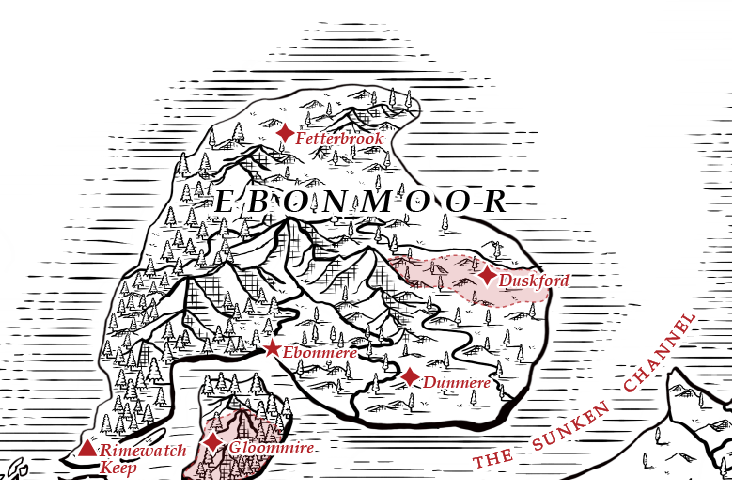
Overview
Dunmere was built around fertile fields, pastures, river water, cattle, hogs, grain, and the trades needed to preserve and distribute food. Agriculture shaped ordinary life more strongly than noble politics, and local families developed long traditions of farming, herding, butchery, smoking, and preservation.
After Duskford fell, displaced people arrived in Dunmere and helped expand fields, irrigation, storage, and livestock enclosures. The town became even more important to Ebonmoor's food supply.
Crops still grow, but the livestock are failing. Cattle become restless, refuse food, develop darkened veins and swelling, and may deteriorate rapidly. The symptoms resemble the Rotmire Blight closely enough to cause fear, though no cause has been publicly established and Dunmere's people have not shown the same pattern.
History
Dunmere and Duskford once formed the agricultural backbone of Ebonmoor. Dunmere produced much of the food while Duskford helped move surplus into wider trade.
Duskford's fall severed that relationship and placed enormous pressure on Dunmere. Production was expanded, refugees were absorbed into the agricultural workforce, and House Wilthorne increased defenses along the routes leading toward the ruined district.
The livestock sickness emerged after Dunmere had already become the island's most important remaining food source.
Present Day
Food production continues under strain. Grain and vegetables remain available, while meat and livestock reserves decline.
That makes every sick animal more than a farmer's loss. Each failed herd threatens butchers, stores, rationing, transport, and the island communities that now depend on Dunmere to replace what Duskford once produced.
Rumors blame river water, corrupted soil, air, the Blight itself, or divine punishment. None of these explanations is publicly proven.
Local decisions are increasingly made through a council of farmers and butchers operating beneath the broader authority of House Wilthorne. Rationing, culling, military protection, hoarding, and smuggling have all become sources of tension.
Notable Locations
Stonehall Market
Stonehall Market was once the center of regional agricultural trade. It now serves as a major point for rationing, controlled sales, and disputes over dwindling supplies.
Kaelssen Ranch
Kaelssen Ranch is one of Dunmere's largest livestock operations and has been heavily affected by the current animal sickness.
The Farmer's Keep
The Farmer's Keep is the principal meeting place for the local agricultural council and for decisions concerning food distribution and livestock culling.
The River Gate
The River Gate is a principal access point to the waterways that feed Dunmere's fields and herds. Because the cause of the livestock sickness is unknown, the water itself has become a source of suspicion.
Campaign Developments
Livestock Contamination Traced
Recent investigation identified two concrete contamination routes affecting livestock around Dunmere without establishing a single cause for every sick animal in the region.
Near Dunmere, runoff from an animal burial trench was found feeding a constructed drain connected to affected water. Farmers began keeping livestock away from the suspect supply, warning downstream farms, isolating the contaminated drain, and organizing excavation and cleanup.
A separate investigation in ruined Duskford recovered records and physical evidence linking one southbound livestock transfer to contaminated stock water at the old quarantine exchange. A failed drainage path had backflowed into the trough system before the animals were sent toward Dunmere. Those findings were later reported to Dunmere's relief workers.
The evidence establishes specific exposure routes and explains at least part of the livestock crisis. It does not establish that every later case in Dunmere had the same source, and it does not amount to a cure for the Rotmire Blight.